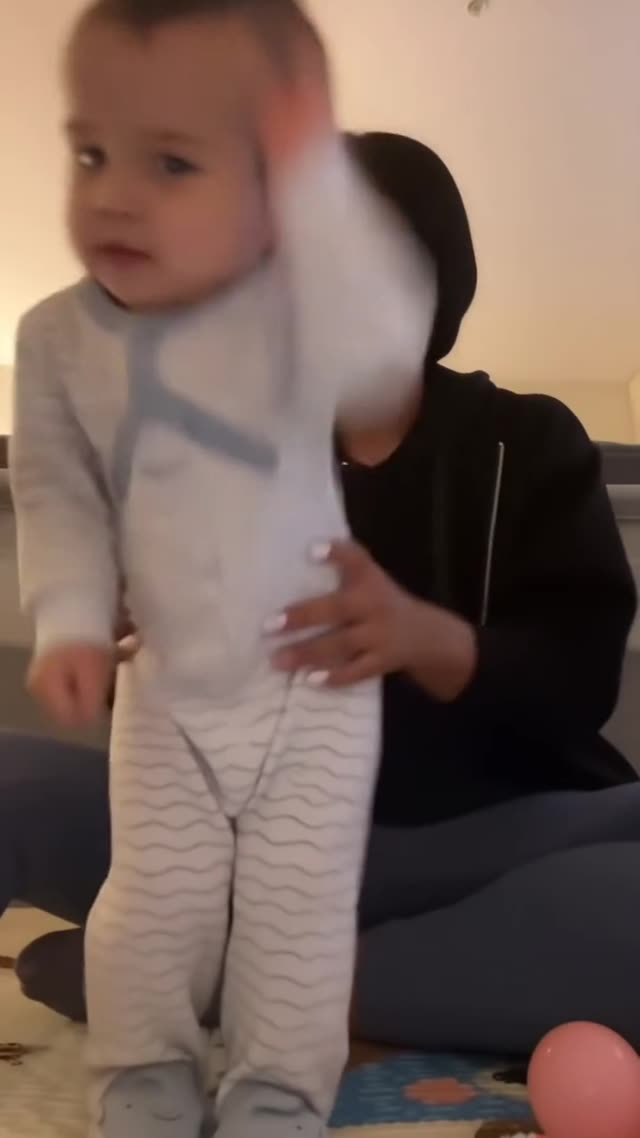
The Young Folks AI baby dance is a 14-second clip in which a baby in a light-blue romper sways, squats, kicks one leg and bounces toward the camera on a white bed. On videosi you make it from one photo of your own baby, and the MP4 you download already has the template's sound on it.
This guide goes past the trend page FAQ: how the 14 seconds are built, how new the trend really is, what the name does and does not tell you, and what to check before you upload a photo of your child.
Key takeaways
- Young Folks is a CapCut template created on 24 October 2026, with about 22,000 uses by 2 November 2026, so it is only just starting.
- The song is unconfirmed, and the 2006 single with the same name has not been shown to be the source.
- Upload only a photo of your own baby, as a parent or legal guardian aged 18 or older, in everyday clothes.
- A standard 14-second video costs 12 credits, and a failed render returns them.
- The caption "Wait until your baby starts dancing" is used on many other AI baby templates, so not every clip with it is this one.
In this guide
- What happens second by second in the Young Folks baby dance?
- How new is the Young Folks trend?
- Is every "Wait until your baby starts dancing" video the same trend?
- Does the name Young Folks mean the Peter Bjorn and John song?
- Whose photo can you use?
- Which clothes and framing work best?
- Why does the face matter less here than in a close-up trend?
- What does one video really cost?
- Should you label the video as AI when you post it?
- When should you pick Young Folks over a closer baby trend?
What happens second by second in the Young Folks baby dance?
The clip runs just under 14 seconds in one continuous, static shot, with no cuts and no camera movement. That matters, because everything you see comes from the baby alone. The baby stands on a white bed in a bright bedroom and lifts both hands to the head. Then comes a sway, a drop into a low knee-bend bounce, and one leg kicked out to the side.
The ending is the part viewers remember: the baby steps toward the camera and bounces with a big smile. Because the room, the bed and the framing are fixed, the Young Folks template reads as a tiny stage act rather than a candid moment. That is also why your own background is not used. The bedroom is part of the format.
If you want to compare this movement with a closer, face-first trend, the Young Folks page lists the related baby trends that already exist on videosi.
How new is the Young Folks trend?
Very new. The CapCut template was created on 24 October 2026 and had about 22,000 uses on 2 November 2026. The TikTok posts we found that use the name went up on 1 November 2026. The creation date is read from the template's ID, so whether an earlier original exists is unconfirmed.
For a trend, 22,000 uses is an early number. It is enough to show people are making it, and not enough to say it will last. We also have few examples to show you so far, and we would rather say that than pad the page. The trend page will be updated as the template moves, so check it again in a few weeks if you are deciding whether to wait.
Is every "Wait until your baby starts dancing" video the same trend?
No, and this is the most common mix-up. That line is used as a caption on many AI baby dance templates, each with its own sound, its own room and its own moves. Some of them are far more viewed than Young Folks. If you saw a dancing baby under that caption, the template behind it could be any of several.
A quick way to tell: Young Folks has a white bed, a light-blue romper in the original, a squat, a one-leg kick and a final walk toward the lens. If the clip you saw has a different setting or a different ending, it is probably another template. The page for this trend covers only the Young Folks version.
Does the name Young Folks mean the Peter Bjorn and John song?
Not necessarily. Young Folks is also the title of a 2006 single by the Swedish band Peter Bjorn and John, with guest vocals by Victoria Bergsman, released on 7 August 2006 as the first single from the album Writer's Block, according to the Wikipedia article on the song.
The name match is the reason people assume it is the soundtrack. We could not confirm that. The template's sound opens with a sung line about waking from a dream, and we could not match that recording to a released track, including the 2006 single. So treat the song as unknown. What we can say for certain is that the video you download from videosi carries the template's own sound, whatever its source turns out to be.
Whose photo can you use?
Only a photo of your own baby or toddler, uploaded by a parent or legal guardian aged 18 or older. That is a rule of the page, not a suggestion. Do not use another family's child, a photo taken from social media, or a photo of a child you do not look after.
The reasoning is simple. A child cannot agree to appear in a realistic AI video, and a photo you found online was shared with a particular audience in mind. If a friend would like the video of their baby, they should upload their own photo. The Young Folks baby dance is built for families making something for themselves.
Which clothes and framing work best?
The baby keeps the clothes from the photo, so pick an ordinary, everyday outfit: a T-shirt, a romper or a onesie. Do not upload bath, beach or nappy-only photos. Those are excluded for the same reason as the rule above, and the dance would not suit them anyway.
Because the dance is full body, a full-length photo gives the model arms, legs and clothing to work from. A tight crop of the face leaves it guessing at the rest. Choose a sharp, recent photo taken facing the camera in even light. Hats, dummies and a hand over the mouth all make the result worse, since they hide exactly what the model needs to hold steady.
Why does the face matter less here than in a close-up trend?
It matters just as much, but it is harder to keep. In a full-body shot the face is small for most of the 14 seconds, so there are fewer pixels carrying your baby's likeness. During the squat, the kick and the turns toward the camera, the likeness can drift.
Likeness is not guaranteed, and we would rather say so up front. If the first result looks like a cousin of your baby rather than your baby, the usual fix is a better photo, not a different setting. A render that fails, times out or is blocked returns its credits automatically, so a retry with a sharper picture costs you nothing extra for the failed attempt.
What does one video really cost?
A standard 14-second video (Standard model, 720p) is 12 credits. Better models and higher resolutions cost more. The smallest credit pack is $6.90 for 10 credits, which is slightly under one standard video, so most people start with the $17.99 pack of 30 credits, which covers two standard videos and part of a third. Monthly plans start at $29.90 for 100 credits. Every generation is paid for in credits, with no trial render.
Credits in packs do not expire. The video is made with ByteDance's Seedance model, with Seedance 2.0 Mini as the default and heavier options one click away. You never write a prompt: the dance and the bedroom are built in, and you choose only the photo and the format (9:16, 1:1 or 16:9).
Should you label the video as AI when you post it?
Yes, and the platforms increasingly expect it. YouTube, for example, asks creators to disclose realistic content that is AI-generated or altered, through the "AI use" setting in YouTube Studio, and says creators who repeatedly fail to disclose can face labels or penalties. Its rules are set out on YouTube's page on disclosing altered or synthetic content.
A baby dancing on a white bed is a scene that never happened, and it looks real. So it is safest to tick the AI box wherever the platform offers one, and to say so in the caption. Also think about the audience before you post: a video of your child is easy to copy and hard to take back, so share it with family or a private account if you are unsure.
When should you pick Young Folks over a closer baby trend?
Pick Young Folks when you want movement. It is a full-body dance with a squat, a kick and steps toward the camera. A closer trend such as Thank You Baby is a 15-second grin and head tilt, and Strawberry Baby puts an adult's face on a dancing strawberry figurine. All of them need one photo.
If your best photo of your baby is a face close-up, a closer trend will suit it better. If you have a good full-length shot in everyday clothes, Young Folks is the one that uses it. And if you just want to see what the new template looks like with your own child in it, start from the Young Folks page, upload one photo and press Generate.