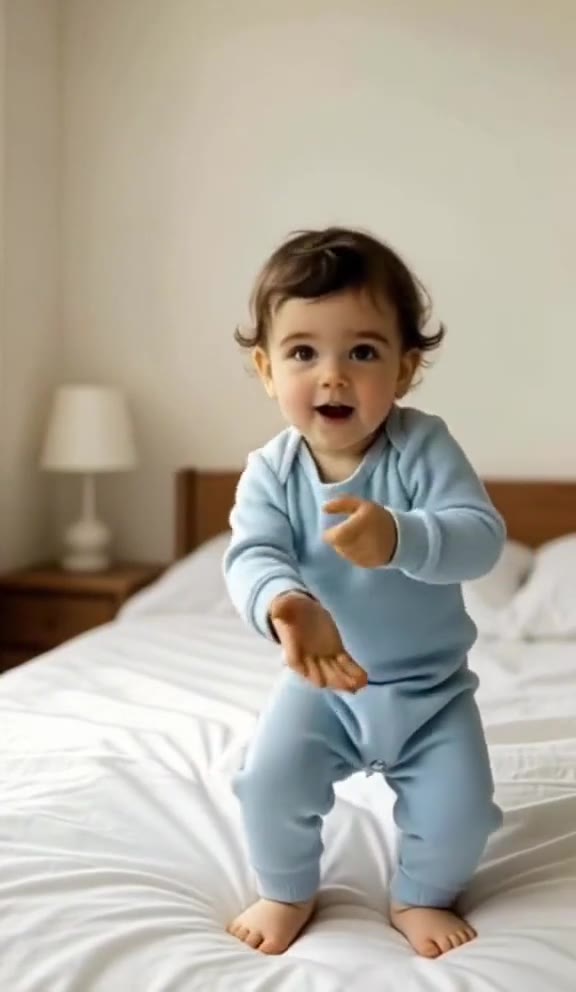
Nobody has proven whether the viral newborn with a thick mustache is real, but the best available evidence points to a digitally altered clip rather than a baby born with facial hair. The baby with mustache AI trend that followed is plainly synthetic fun, and you can make your own harmless version from one photo.
This guide answers the questions people actually type about the clip: where it came from, what fact-checkers said, what newborn hair really looks like, and what to do if you want to make a version starring your own child or yourself.
Key takeaways
- The first clip we found was posted on TikTok on 21 October 2026, and its authenticity is unconfirmed.
- Fact-checkers reported signs of digital alteration, but no one has shown exactly how it was made.
- Normal newborn hair (lanugo) is fine and soft, so it does not explain a dark, sharp mustache.
- The AI version is a joke format: use only your own child or your own photo, and label the result as AI.
- On videosi a 10-second video costs 10 credits at Standard 720p, and failed renders return their credits.
In this guide
- What is the baby with mustache clip?
- Is the baby real or AI?
- Can a newborn actually have a mustache?
- Why did it spread so fast?
- What does the joke mean?
- How can you spot an altered clip?
- How do you make your own version?
- Whose photo can you use?
- Should you label it as AI?
- How much does it cost?
- Why might the baby not look like yours?
What is the baby with mustache clip?
It is a short phone-style video of a newborn wrapped in a cream towel on a hospital bed with a blue sheet. The baby squints, blinks slowly, turns its head and stares at the camera while a dark, grown-up mustache sits on the upper lip. Near the end an adult hand strokes the chin.
The earliest post we found is a TikTok video dated 21 October 2026. Press coverage described the same scene: a baby on blue hospital sheets in a towel, with what looks like a mustache and a small patch of hair on the chin, according to Free Press Journal. The trend page at /baby-with-mustache-ai has the beat-by-beat breakdown, so here we focus on the questions around it.
Is the baby real or AI?
The honest answer is that it is unconfirmed. Free Press Journal said it had not independently verified the video and that the place and date of the birth are unknown. Some viewers suspected AI, while others reacted as if it were a genuine newborn.
The strongest claim comes from a fact-check cited by IBTimes UK. Boatos.org, dated 24 October 2026, concluded that the facial hair was digitally added, likely with an AI filter. Its visual evidence was that the mustache changes position and appearance as the baby moves, and at one point disappears, and that its texture and lighting do not match the rest of the image.
That conclusion rests on visual clues, not a forensic check of the original file. The same report lists what is still unknown: the child's identity, the birth location, the hospital, the original upload, the editing software and whether the baby itself is real. So the careful reading is "shows signs of digital alteration", not "proven fake" and not "proven real".
Can a newborn actually have a mustache?
Not in the way the clip shows. Babies are sometimes born with lanugo, the soft, fine hair that covers a fetus. According to Dr. Greene, lanugo is normal and harmless, covers most of the body but not areas such as the palms, soles and lips, and is mostly shed in the 7th or 8th month of pregnancy. It can persist for a few months after birth, especially in babies born early.
So a few extra fine hairs on a newborn are ordinary. A thick, dark, neatly shaped mustache with a goatee patch is a different thing. IBTimes UK makes the same point: lanugo does not explain a dark, well-defined mustache. We are not giving medical advice here, only explaining why the clip looked so surprising. If you have questions about your own baby's hair or skin, ask your pediatrician.
Why did it spread so fast?
Three things made it easy to share. The scene is instantly readable in one second, the face is a close-up with a funny contrast between tiny and serious, and nobody could settle the real-or-fake question, which kept people commenting.
Reposts with captions such as "born with work experience" spread across Spanish-speaking TikTok from 22 October, and a 24 October repost by a large US media account had about 5.6 million views by 3 November. News sites in several countries asked whether the baby was real. Within days AI accounts began posting their own mustache newborns, which is why the trend now has two layers: the original mystery clip and the openly AI remakes.
What does the mustache baby joke mean?
It is a joke about a baby who arrived already looking like a middle-aged man. Commenters quoted by IBTimes UK called the baby "the youngest senior citizen" and a "distinguished gentleman straight out the womb". The humor works because the baby is calm, cosy and a little serious, while the mustache signals experience and authority.
That is also why the AI version stays harmless when it is done well. The baby is swaddled to the shoulders, happy or sleepy, and the only gag is the facial hair. There is no mockery of how a child looks and nothing suggestive. If a variation would embarrass the child once they grow up, skip it.
How can you spot an altered clip like this?
The fact-check gives a good template. Watch the part that should be attached to the skin and ask whether it behaves like skin.
- Does the feature stay fixed when the head turns, or does it slide and change shape?
- Does it ever vanish for a frame or two?
- Do the texture, sharpness and lighting match the face around it?
- Can anyone name the original poster, place and date?
None of these is proof alone. They are reasons to hold back before sharing a clip as a real birth. A missing source is itself a warning, and a caption claiming "this is real" without a source is not evidence.
How do you make your own baby with mustache video?
You upload one photo and pick a style. On the baby with mustache AI page there are four steps: upload a sharp, front-facing photo, choose a classic thick mustache or a curled handlebar, choose 9:16, 1:1 or 16:9, then press Generate. The result is a 10-second MP4 with the original room sound and no watermark, saved in My creations.
The reference clip sets the movements and timing, so you do not write a prompt. Your photo supplies the face, eyes, hair colour and skin tone. Rendering takes several minutes, so you can leave the page and come back.
Photo tips that matter most for newborn-style footage:
- Use a clear, recent face photo in even light, without filters or heavy shadows.
- Keep the mouth and nose clear, because the mustache needs an open upper lip to sit on.
- Choose a normal, dressed everyday photo. The scene shows the baby in a towel up to the shoulders, so bath or nappy-only photos are not appropriate.
You can also upload a photo of yourself. The tool then makes a newborn version of you, keeping your eye shape, nose, eyebrows, hair colour and skin tone, which is a popular twist for friends and family group chats.
Whose photo can you use?
Only your own. The baby version takes a photo of your own child, uploaded by a parent or legal guardian aged 18 or older. The other option is a photo of yourself. Photos of other families' children, strangers or pictures saved from social media are not allowed.
This rule is not only about the tool. A baby cannot consent to appearing in a viral joke, so the adult who posts it carries that choice. Think about whether you would be comfortable if the child saw the video at 15, and keep the content to the gentle gag the format is built for.
Should you label the video as AI?
Yes. The original clip caused confusion precisely because many people took it for a real birth, and versions circulated in several languages presented as real. If you post an AI version, turn on the platform's AI-generated label and say so in the caption.
It costs nothing and keeps the joke a joke. It also protects you: relatives and friends who see a baby with a mustache in a hospital bed may briefly believe it, and a clear label avoids worry or awkward replies. Adding your own song is fine, since the trend has no single sound.
How much does it cost?
It is not free: there is no free generation or trial. A standard 10-second video (Standard model, 720p) uses 10 credits. The Single pack is $6.99 for 10 credits, which covers one Standard 720p video, and the Basic plan is $29.90 a month. Better models and higher resolutions cost more credits.
If a render fails, times out or is blocked, the credits come back automatically. Because the first result may not be perfect, it helps to choose your best photo before you press Generate rather than after.
Why might the baby not look like yours?
Newborn faces look very alike to a video model, so likeness is the hardest part. It is not guaranteed, and it drifts more when an adult photo is turned into a newborn, because the proportions have to change while the eyes, nose and colouring stay recognisable.
The fixes are practical. Use a sharper photo, one face only, nothing over the mouth, and a recent picture where your baby's features are clear. If your baby's hair is very light, the tool picks a darker mustache colour so it stays visible. When you try again, change the photo rather than repeating the same one.
For the full picture of the trend, its timeline and the shorter FAQ, see the baby with mustache AI page.