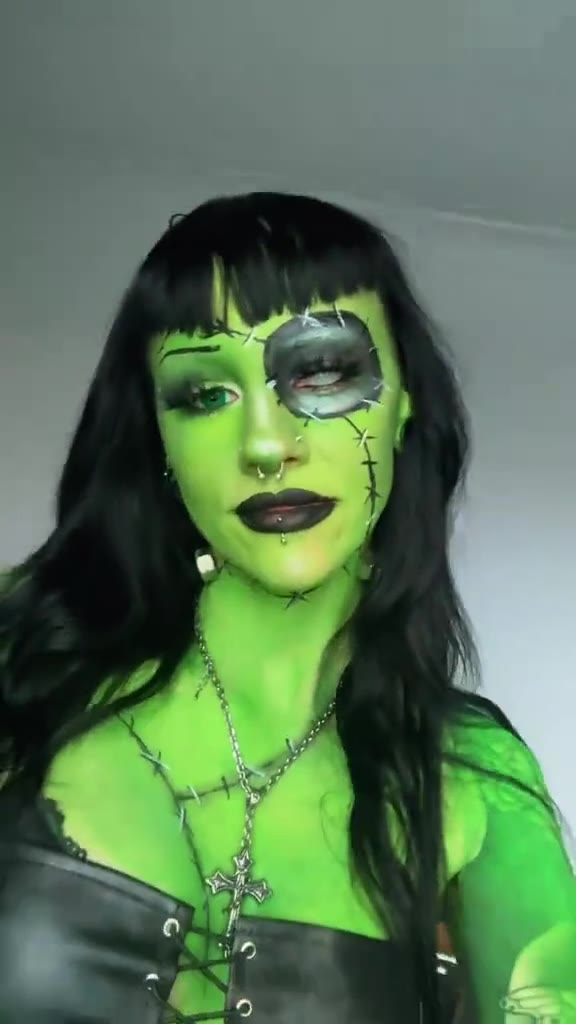
A Clayface AI video is a short portrait clip in which a person drags one hand down their face and everything under the hand turns into smooth, featureless clay. You can make one from a single photo on the Clayface AI page, with no prompt and no photo booth. This guide goes past the basics and explains how the effect works, why it behaves the way it does, and how to get a clip you actually want to post.
videosi is an independent tool. It is not affiliated with, endorsed by or connected to DC, Warner Bros. or the makers of the film. The effect copies one visual idea, a face melting into clay under a hand, and nothing else.
Key takeaways
- The effect is a 5 second portrait: you look at the camera, a hand slides down your face, and the skin it touches becomes glossy, eyeless clay.
- Only the face changes. Hair, neck, hand and clothes stay normal, and this is not a movie monster costume.
- Your face is on screen as itself for only about 1.5 seconds, so a sharp, front-facing photo matters most.
- A Standard 720p clip costs 10 credits. There is no free generation, and a failed render returns its credits.
- Use only photos of adults who agreed, and label the result as AI when you post it.
In this guide
- How did the original booth work?
- Why does only the face turn to clay?
- What happens second by second?
- How do I take the best photo?
- Is it the monster from the film?
- What is the film timeline behind the trend?
- How is it different from a claymation filter?
- Can I make a set of clips?
- Should I tag it as AI?
- What if the result is wrong?
- What does a batch cost?
How did the original photo booth work?
The trend began with an interactive AI booth at horror and fan events in the United States in October 2026. A visitor stood in front of a dark backdrop, covered their face with a hand, and a moment later received a short clip of their own face melting into clay. The earliest booth clips we found on TikTok are dated 6 October 2026, and the format was easy to copy because the framing never changed: head and shoulders, still camera, plain dark background, one hand.
That fixed framing is the reason the trend spread. Every clip looks like a sibling of the others, so a viewer recognises the format in the first second.
The Clayface AI page rebuilds that fixed shot. The dark backdrop, the framing, the speed of the hand and the timing are all built in. You supply only the face.
Why does only the face turn into clay?
The key to the look is restraint. A model asked for "a clay person" tends to melt the whole head, or invent a brown mud monster with a lumpy body. That is not what the booth clips show. In the original, the change follows the hand: wherever the palm has passed, the skin becomes smooth and wet-looking, and everywhere else stays human.
To keep that, the generation is told three things. The hair, neck, hand and clothes must stay normal. The clay must have no eyes, nose or mouth, only soft ridges that fold and stretch under the fingers like warm putty. And there must be no blood, wounds or gore. The result reads as eerie and tactile rather than as horror makeup.
This is also why the clip works on almost any face. The clay is a surface treatment of the skin your photo supplies, so the skin tone of the clay follows you, and your hairline and ears remain the cue that it is still you underneath.
What happens second by second?
The clip is five seconds long, and the timing is the whole joke.
- From 0 to 1.5 seconds you look straight into the camera with your own hand resting on your forehead. You should be clearly recognisable here.
- From 1.5 to 3 seconds the hand slides down over the eyes and nose, at the same unhurried speed as the original booth clip.
- From 3 to 5 seconds the area under the hand has become smooth, glossy clay, folding into soft ridges as the fingers move on.
Because the reveal is slow, nothing is hidden by a cut. The clip is one continuous shot with no cuts, which is what makes the melt feel physical.
How do I take the best photo for a Clayface AI video?
Your photo supplies the face, hair, skin tone, hands and the top you are wearing.
- Face the camera straight on. A side profile gives the model too little of the front of your face.
- Use even light, ideally from a window in front of you. Heavy shadows get baked into the face.
- Show head and shoulders, with your hands out of the frame or relaxed, because the clip draws its own hand.
- Skip sunglasses, hats, masks and heavy filters, which are the usual causes of a start that does not look like you.
- Choose one person. The page is built for exactly one adult, so crop group shots or make one clip per person.
Likeness is never guaranteed, but a sharp photo gives you the best odds. If you only have a dim selfie, retake it before you spend credits.
Is the effect the monster from the film?
No. The film's creature is a shape-shifting clay villain, and the character has a long history in comics. According to Wikipedia, the original Clayface, Basil Karlo, first appeared in Detective Comics #40 in June 1940, created by Bill Finger and Bob Kane, and later versions have clay-like bodies and shape-shifting powers. You can read more on the Clayface character page.
The videosi effect does not recreate that design. There is no muscular mud body, no logo and no poster frame. It is simply a face turning into smooth clay under a hand, which is the one idea the booth borrowed for its clips.
What is the film timeline behind the trend?
The trend is tied to a real release schedule. Per the Clayface film article on Wikipedia, the 2026 body horror film directed by James Watkins premiered in Los Angeles on 13 October 2026 and opened in United States cinemas on 23 October 2026. It is produced by DC Studios and 6th & Idaho and distributed by Warner Bros. Pictures.
Set that against the booth clips. The earliest we found are from 6 October, a week before the premiere, and a clip posted on 10 October passed 120,000 views. So the trend started as promotion, peaked in the weeks around the opening, and was still spreading in early November 2026. If you are posting for relevance, the window while the film is in cinemas is the strongest.
How is this different from a claymation filter?
A claymation filter restyles an entire video so everything looks stop motion: the room, the person, the movement. It is a style applied to the whole frame, usually with chunky, jerky motion on purpose.
The Clayface AI effect is the opposite. The room stays a plain dark studio, your hair and clothes stay photographic, and the movement is smooth and real. Only the patch of skin the hand has covered changes into clay, which is why it surprises people. A filter says "this is a cartoon". The melt says "something is wrong with this face". If you want a cute clay look, pick a claymation style. If you want the uncanny version, this is the one.
Can I make a set of clips for friends or a series?
Yes, with one rule: every person must be an adult who has agreed. Each clip uses one photo of one person, so a group needs one run per person. Photos of celebrities, public figures and minors are not accepted, and you must be 18 or older to use the page.
Keep the original sound if you can. Every clip comes with the trend audio attached, and it is part of why the format is recognisable. Start from the Clayface AI generator and repeat with each new photo.
Should I tag the video as AI when I post it?
Yes. The clip is synthetic, and a plain label protects you and your viewers. Most large platforms ask creators to disclose realistic AI content, and many offer a built-in toggle for it. Using it costs you nothing, and it avoids the situation where a friend wonders whether your face really did that.
What should I do if the result is wrong?
Most problems come from the photo, not the effect. If the start does not look like you, retake the picture under the guidelines above. If the face looks too narrow or too round, the usual cause is a tilted head or a wide-angle selfie taken too close, so step back and zoom in slightly instead.
If a render fails outright, the credits are returned automatically. If it finishes but is simply not what you wanted, remember that purchases are final, so it is worth checking the photo before you press Generate. The finished MP4 has no watermark, and if you leave the page it waits in My creations.
What does making a batch cost?
There is no free generation and no free trial. A Standard 720p clip is 10 credits. Credit packs start at $6.99 for 10 credits and never expire, so you can buy a small pack once and use it across several photos over time. Subscriptions start at $29.90 a month and suit people who make clips regularly.
For a one-off, a small credit pack is the simple choice: one photo, one clip, nothing recurring. For a friend group or a series, work out how many people you need and buy the pack once.
When you are ready, open the Clayface AI page, upload one clear photo, choose your ratio and press Generate. The hand, the clay and the timing are already set up for you.