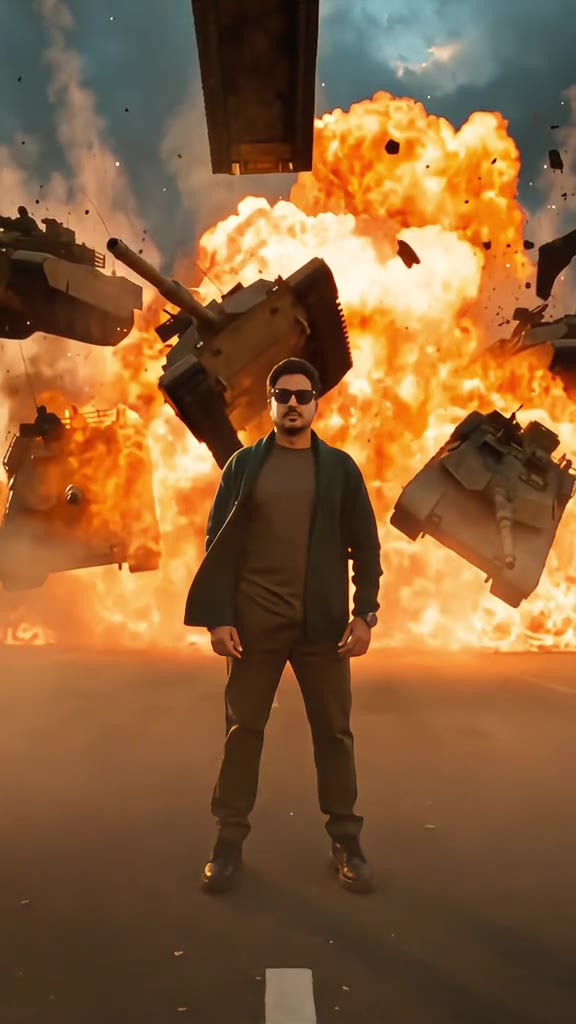
The ATEEZ BAD AI clip is an 8-second video of you doing the BAD dance challenge, made from one photo of you. This guide goes past the basics on the trend page: where the song comes from, what each beat looks like, and what decides whether the result looks like you.
Key takeaways
- BAD is the title track of ATEEZ's 14th mini album, GOLDEN HOUR : Part.5, released on 26 June 2026.
- The routine on the page is six beats in 8 seconds, and the X-arms and the side lunge are what make it read as BAD.
- You dance as yourself: no idol face, no stage outfit, no official music video.
- The clip is silent; add the song and the AI label where you post.
- An 8-second Standard 720p video costs 7 credits, with packs from $6.99 for 10 credits.
In this guide
- What is BAD, and which album is it from?
- Which songs sit next to BAD on the album?
- How big did BAD get?
- Is there a Japanese version, and does it change the dance?
- What are the six beats of the dance, second by second?
- Which beat is hardest for an AI video to hold?
- Why a plain riverside plaza and not a stage?
- Which photo and outfit give the best result?
- How do you add the song and label the post?
- Is it too late to post, with Part.6 coming?
- What does one try cost?
What is BAD, and which album is it from?
BAD is the title track of GOLDEN HOUR : Part.5, the 14th mini album by the K-pop group ATEEZ. According to the Namane Card report, the album came out on 26 June 2026 at 1 p.m. KST and is the fifth entry in the GOLDEN HOUR series.
The dance challenge that grew around the chorus is a fan phenomenon, not a piece of official promotion we can describe. We do not know who first posted the challenge choreography, so this guide does not name anyone, and we do not quote view counts or hashtag totals because we have not verified them.
Which songs sit next to BAD on the album?
The same report lists five tracks: BAD as the title track, then MAMACITA, TOXIN, Fallin and Body. That matters for one practical reason. People searching for the dance sometimes land on videos for a different track from the same album, and the BAD routine is the one with the fists at the chest, the wide squats and the arms crossed overhead.
If you are picking a sound in TikTok or Reels, check that the track name says BAD and not one of the other four. The ATEEZ BAD AI page only covers the BAD routine.
How big did BAD get?
Big enough that the chart numbers are easy to find. The Namane Card report says the album debuted at No. 1 on the Billboard 200, the group's third time at the top, and that BAD won KBS Music Bank on 3 July 2026 with 9,688 points, the group's first Music Bank trophy. It adds a second win on 10 July 2026.
The Sports Kyunghyang piece, published in October 2026, also puts Part.5 at No. 1 on the Billboard 200 and says BAD kept ranking high on music sites after promotions ended. The two sources give slightly different first-week unit figures, so we quote none. What both agree on is the point that matters here: the song had a long second life, which is the soil a long-running dance trend grows in.
Is there a Japanese version, and does it change the dance?
Yes. The Kpop Official album page lists a Japanese release dated 29 July 2026, a six-track single with BAD (Japanese Ver.) as the title track, plus Seeker, HIGHER and instrumental versions of all three.
The dance does not change with the language. The AI clip you make here is silent, so which version of the song you lay under it is your choice at posting time. The Japanese version is useful if your audience is in Japan; for most feeds the original is what people recognise. Either way, you pick the sound inside the platform.
What are the six beats of the dance, second by second?
The part used on the page is 8 seconds long, built from an AI-made clip of an ordinary dancer, not from the group or the official video.
- 0 to 1 s, fist bounce. Knees bent, both fists bounce at the chest on the beat while the shot settles on your full body.
- 1 to 2 s, chin pose. Straighten up with one hand at the chin and the other fist at the chest, eyes on the camera.
- 2 to 3 s, squat and X-arms. A wide-legged squat with the arms low, then both forearms snap into an X above your head.
- 3 to 5 s, low hands. Back into a wide squat with open hands low at the sides, then up with fists at the waist.
- 5 to 6 s, diagonal punch. A wide stance, one arm punching up on a diagonal while the other crosses the chest.
- 6 to 8 s, side lunge. A deep lunge to the side with one hand reaching for the ground, then rise and finish facing the camera.
To learn it yourself, practise beats 3 and 6 slowly, since the squat into the X and the lunge are where balance goes. To skip practice, the ATEEZ BAD AI generator does the six beats for you.
Which beat is hardest for an AI video to hold?
The side lunge, and it is not close. Deep squats and a body leaning towards the floor turn the head, shrink the face in frame and change the angle of the shoulders, and that is where a video model tends to drift into a different person. The X-arms are second: forearms crossing in front of the face can blur a hand for a few frames.
Two things in the setup are there for exactly this. The first is an identity lock that treats your photo as the only source for face, hair, build and outfit. The second is a rule that your full body, head to shoes, stays in frame after the first second, so the lunge never crops your face out. Even so, likeness is not guaranteed, and a hand may blur briefly. If a render fails, times out or is blocked, the credits come back automatically.
Why a plain riverside plaza and not a stage?
Because the trend is a challenge video, not a concert. Ask a general video model for the BAD dance by name and it tends to invent a stage, a crowd of backup dancers and matching black outfits, or a generic hip-hop routine. A plain sunny riverside plaza with a distant skyline keeps the clip looking like someone filming a challenge on a phone, with one person, one take and the camera at chest height.
It also keeps the result clearly yours. There are no group costumes, no spotlights and no idol styling to confuse the face. The scene is fixed by the trend, so the only choices you make are the photo and the format.
Which photo and outfit give the best result?
Pick a photo where you stand, face the camera and show your whole body from head to shoes in even, bright light. The outfit in the photo is the outfit you dance in, so choose it first.
- Show the legs. The dance is squats and a lunge. A photo that crops at the waist leaves the model guessing your stance.
- Wear something readable. Jeans and a plain T-shirt or a jacket show the wide stances clearly. A long dress can hide them.
- Keep the face clear. Skip sunglasses, masks and caps pulled low.
- Avoid dark or blurry selfies. They tend to drift during the fast arm moves.
Then pick 9:16 for TikTok and Reels, or 1:1 or 16:9. Only use your own photo or one from someone who agreed, and no photos of celebrities, idols or children.
How do you add the song and label the post?
The download is a silent MP4 without a watermark, so the song is the last step, and it belongs inside the app. Upload to TikTok or Reels, pick the BAD sound from the platform's own library, where its licence covers the music, and line the X-arms up with the chorus. Do not bake a copy of the song into the file.
Then label it. Platforms such as TikTok ask creators to disclose realistic AI-generated content, and a clip of you dancing when you did not dance is exactly that. Switch on the AI label in the post settings. videosi is independent and not affiliated with ATEEZ or KQ Entertainment.
Is it too late to post, with Part.6 coming?
Not if you are posting for yourself or for search. The song came out on 26 June 2026, AI versions followed in July, and our trend radar saw a fresh wave of clips on 24 October 2026. That puts the trend in a second round, not at its peak.
A new release can lift it again. The Sports Kyunghyang article reports that KQ Entertainment announced GOLDEN HOUR : Part.6 on 8 October 2026 through a spoiler video, with release on 13 November 2026 at 2 p.m. We cannot say whether Part.6 will bring more attention to BAD, but the weeks before a comeback are often busy for the group's fans. If you want a post ready, the BAD dance page takes about the time of a coffee.
What does one try cost?
An 8-second video on the Standard model at 720p is 7 credits. Better models and higher resolutions cost more, and the generator shows the price before you press Generate. There is no free generation and no free trial.
Credit packs start at $6.99 for 10 credits and never expire, and plans start at $29.90 a month if you make many. A failed render returns its credits. Since the cost of one try is small and the photo is the main variable, change the photo before you change anything else if the first result is off. You can start from the ATEEZ BAD AI page.